 |
 |
 |
 |
 |
 |
 |
 |
 |
 |
 |
 |
 |
 |
 |

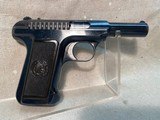
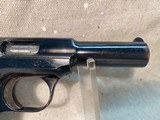
Savage Arms Model 1907 .32 ACP caliber semi-automatic pocket pistol
Guns International #: 102166660 Seller's Inventory #: P38
Category: Savage Pistols - .32 Pistols
Seller's Information
When emailing or calling sellers direct, please mention that you saw their listing on GunsInternational.com

Seller: William Ashley
Member Since: 4/28/21
First Name: William
Last Name: Ashley
State: Michigan
Zip: 48315
Country: United States
Phone: (586) 202-4864
Number of Active Listings: 2
Seller: FFL Dealer
Return Policy: 3 day inspection and return policy on used guns.
Payment Types Accepted: USPS money order, bank checks, personal checks
About Us: No international sales. MI sales tax will be charged on guns and accessories delivered in the state of MI.
Description:
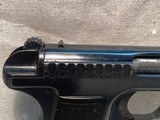
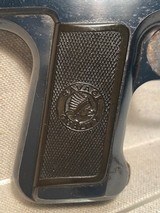
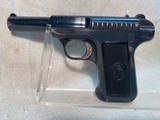
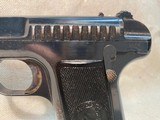
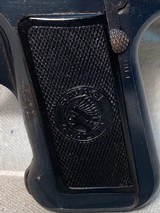
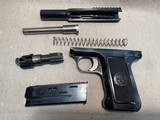
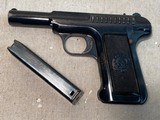
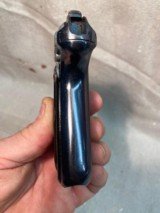
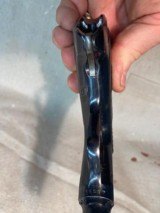
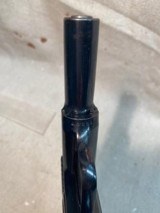
SOLD ******** Pending receipt of funds********* Savage Arms Model 1907 .32 ACP caliber semi-automatic pocket pistol, blue finish, barrel length = 3.75 inches, single action only, SN = 46689, thumb safety, no grip safety, The "double stacked" magazine holds 10 rounds. External (exposed) "burr style" cocking piece. Although the cocking piece looks like a hammer, this gun is striker fired. It has a small blade front sight and a small leaf with a notch on the top of the tubular slide for a rear sight. The Model 1907 in .32 caliber was made between 1908 and 1920. There were approximately 209,801 of these guns manufactured. This gun was made in 1911 and, for change control purposes, was classified as issue # 10 and modification # 2 of that issue. 10 cocking serations on the rear of the slide. "SAVAGE" in large letters does not appear on the left side of the frame above the grip panel. There is not a cartridge indicator inside the ejection port on the right side of the slide. Black rubber checkered rectangular grips that snap into place which include the Savage trade mark/logo of the head of an Indian wearing a headdress and the words "Savage Quality". The grips were made from gutta-percha. Gutta-percha is a tree. Latex derived from that tree can be formed into a rubber-like elastomer.
In 1908, while still essentially a newcomer to firearms manufacturing, Savage boldly introduced their Model 1907 pistol. It was the first of a small family of pocket handguns (including the Model 1915 and the Model 1917) intended to compete directly with Colt’s wildly popular Model .32 ACP 1903, and later Colt's .380 ACP Model 1908 pocket autoloaders.
In the first years of the 20th century, autoloaders were gaining popularity worldwide. Fabrique National in Belgium struck a deal with American arms designer John Browning to manufacture and market his Model 1899 pistol and its new .32 cartridge. It was an immediate hit commercially and with the Belgian military adopting it as the Model 1900. FN’s success with the little autoloader did not go unnoticed at Colt. Colt bought Browning’s next autoloader design and wasted no time getting the Colt Model 1903 into production. It proved a wise decision. Colt’s first foray into the pocket autoloader market was an instant hit with the public. Savage took note and hoped to cut out a share of this market for themselves - eventually.
It took a few years, but Savage discovered the basis for a worthy challenger to Colt’s supremacy in the 1905 patents of Elbert Hamilton Searle, a former U.S. Army ordnance officer at Springfield Armory. In a time of great engineering diversity in autoloading pistol design that sometimes resulted in bizarre-looking, ungainly and impractical firearms, Searle’s patent drawings suggest an advanced grasp of ergonomics and an aesthetic sensibility combined with sound practical engineering. From Savage’s point of view, three unique features of Searle’s designs stood out as the means to achieve a competitive edge over Colt’s Model 1903. They were a turning barrel delayed blowback operating system; a double-column magazine; and a fingertip-operated magazine release button. They incorporated all three in their new Model 1907 Savage Automatic.
The delayed blowback feature allowed the Savage pistol’s slide, and thus the overall gun, to be smaller and lighter than the simple blowback pocket Colt. The Savage weighed only 19 oz. compared to the Colt’s 24 oz. and it was a quarter-inch smaller in height and length, too, despite having the same barrel length. Perhaps the Model 1907's most distinguishing characteristic was that there was not a single screw in the design, and this allowed it to be quickly disassembled without tools. The Savage Model 1907 chambered in .32 ACP was produced from 1908 until 1920 and, from 1913 until 1920, in .380 ACP.
Although smaller in size, it is derived from the .45 semi-automatic prototype pistol Savage submitted to the 1906-1911 US Army trials to choose a new semi-automatic sidearm. After several years of testing, the Savage pistol was one of two finalists but ultimately lost to the Colt entry, which became famous as the Colt Model 1911.
In a notable innovation, the pistol uses a staggered ("double stack," or "double column") detachable box magazine which allows for a 10-round capacity in .32 ACP caliber. While the introduction of this design is commonly associated with the Browning Hi-Power, its use in the Savage Model 1907 predated the patenting of the first prototype of the Hi-Power by over a decade, and its production by almost 30 years.
Savage made two other very similar semi-automatic pistols, with many parts in common with the Model 1907. The first was the hammerless Model 1915; the .32 Model 1915 was made only in 1915 and 1916 and the .380 model from 1915 until 1917. Like the Model 1907, the Model 1915 uses no screws in the grips. The other is the Model 1917, made from 1920 until 1926 in .32 and from 1920 until 1928 in .380.
All of these guns are often erroneously called a Model 1905 because of the date Nov. 21, 1905 date stamped into the top of the slide on all Savage semi-automatic pistols. This is the date Elbert Hamilton Searle was awarded one of his firearm patents, which were the design basis for all of the Savage semi-automatic pistols.
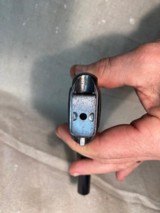
Comes with one magazine. The magazine release hole in the magazine body is located directly above the magazine bottom plate (which is correct for the magazine release design on this gun). The magazine release button, located on the front edge of the grip frame, is intended to be operated by the ring finger of the shooting hand - while the off hand is reaching for the next magazine. A second, like-new magazine is not included in the price of the gun, but is available from the seller at additional cost. Qualifies as a curio and relic.
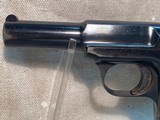
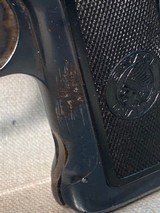
Overall, the gun is in excellent condition for a gun that is 111 years old. There are scratches on the front grip frame next to the left grip panel (see photo). There is minor finish wear from a holster at the muzzle and the leading edge of the frame on the left side. The grips are in excellent condition.
Movie trivia: Watch the 2002 movie "Road to Perdition" . You will be able to clearly identify this same model gun in the hands of two actors (Jude Law in the role of Harlan Maguire and Tyler Hoechlin in the role of Michael Sullivan Jr).
Two additional Savage semi automatic pocket pistols are listed for sale on this site by this same seller (another Model 1907 in .32 ACP caliber and a Model 1917 in .380 ACP caliber).
Shipping to your FFL/C&R only. Inspection must be done on the premises of the receiving FFL/C&R only. Do not remove firearm from receiving FFL/C&R before inspection is completed and firearm is accepted. We provide a 3 day window to complete reasonable inspection. Inspection starts on date of delivery to receiving FFL/C&R. Do not disassemble. If you are unsatisfied, do not complete transfer. Promptly return item using original packaging. We do not refund shipping cost from the seller to the buyer. We also do not reimburse return shipping cost. Add shipping cost of $35.
SOLD
Curio/Relic: Yes
Handgun Caliber: .32 ACP (7.65x17mm Browning SR)