 |
 |
 |
 |
 |
 |
 |
 |
 |
 |
 |
|

VERY GOOD PAIR OF EARLY STERLING SILVER MOUNTED WOGDON OFFICERS' OR HOLSTER PISTOLS
Guns International #: 102537280 Seller's Inventory #:
Category: Antique Pistols - Flintlock - Handguns - English Pistols
Seller's Information
When emailing or calling sellers direct, please mention that you saw their listing on GunsInternational.com

Seller: Matt's Custom Guns
Member Since: 3/18/20
First Name: Matt
Last Name: McGraw
State: Indiana
Zip: 47331
Country: United States
Phone: (765) 825-3418
Number of Active Listings: 6
Seller: FFL Dealer
Return Policy: 3 day inspection and return policy on used guns.
Payment Types Accepted: Visa, Master Card, Money Order, Cashiers Check
Description:
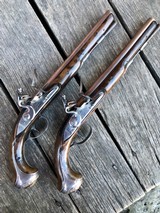
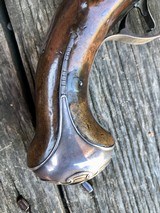
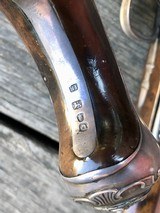
This early pair of sterling silver mounted officers' or holster pistols by the venerable Robert Wogdon can be precisely dated to 1771 by the hallmarks on the tang of the trigger guards - a lion passant guardant indicating the quality of the silver as sterling, a crowned leopard's head indicating the silver was assayed at the London assay office, and a "Q" within a square shield date mark indicating 1771 as the date of assay.
Robert Wogndon was born in 1737 and was apprenticed to the Irish gunmaker Edward Newton of Grantham, Lincolnshire. (Interestingly, two other extraordinary gunmakers, John Manton and his younger brother Joseph Manton (whom W. Keith Neal and D. H. L. Back called the "King of the Gunmakers"), were also born at Grantham in Lincolnshire in 1752 and 1766, respectively, and both were also apprenticed to Edward Newton. Perhaps there was something in the air at Grantham in Lincolnshire or in the workshop of Edward Newton that produced such extraordinary gunmakers.) Wogdon moved to London in 1764 and set up shop at Cockspur Street, Charing Cross. We know these pistols were made there as Wogdon relocated to Haymarket in 1774. Wogdon is considered one of the preeminent British gunmakers of the Georgian and early Regency era. His speciallty was dueling pistols. In fact, his name became so synonymous with the ritual that a duel was commonly referred to as a "Wogdon affair." British collectors know that Frederick, Duke of York is said to have used a Wogdon when he squared off against Lieutenant Colonel Lenox in 1789. In the United States of America, Wogdons were used in the famous dule between Aaron Burr and Alexander Hamilton. As a futher testament to Wogdon's association with duels, a poem written in 1783 entitled Stanzas on Dueling leads off with this salute: "Hail Wogdon! Patron of that Leaden death . . .."
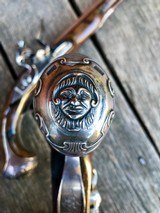
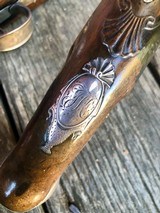
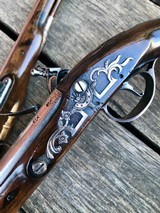
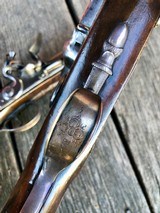
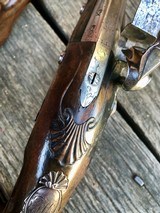
The sterling silver mountings on these pistols - the grotesque mask pommels with long side tangs, the ornate wrist escutcheon, the trigger guard, the sideplate, the entry thimble and the thimble - are stunning and in lovely fine or even excellent condition.
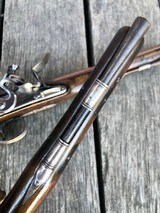
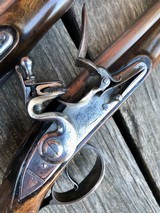
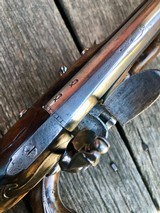
The iron, however, appears to have been let to corrode some time ago. The wood is stained dark adjacent to the lock, barrel, and all the pins as if from iron oxidation. Otherwise, the wood is in good condition with the exception of a small patch - approximately one inch long by three-eigths inch wide above the tail of the lock on one of the pistols. Neither the lock, barrel, nor any of the mountings are proud of the wood. Even the lovely relief carved shell and vine on the wrist of each pistol is strong as if undisturbed. The lock and barrel, however, have been harshly cleaned at some point. As spots of pitting here and there among the otherwise bright finish this was undoubtedly to remove rust. The "Wogdon" name on the lockplates is quite prominent and ledgible although thinned some. The engraving on the standing breach is thinned significantly but the pattern is mostly discernable, more prominent on one than the other. These could certainly be touched up. The about .62 caliber smoothbore barrels are marked "Wogdon LONDON" with a decorative border. This is discernable atop the breach of one of the pistols sufficiently that it could be touched up too. The makers name and city is gone from the other though part of the decorative border is visible. With the other pistol as a reference this too could be touched up. The proof marks on the left side of the breech of each barrel are visible but thinned. The ramrods appear to me to be replacements although the long iron corkscrew patch puller at the tip end of one of the rods appears original. The other rod has no matching tip but I wonder if it isn't stuck in the ramrold hole.
Mechanically, the guns are fine with strong mainsprings and frizzen springs.
As most always, we're left to speculate about the life of these wonderful pistols. Who knows when they crossed the pond? Perhaps they saw the American Revolution.
SOLD