 |
 |
 |
 |
 |
 |
 |
 |
 |
 |
 |
 |
 |
 |
 |

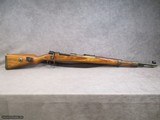
Mauser Karabiner 98k d.o.t. Waffenwerke Brunn I 1944 7.9x57mm Mauser
Guns International #: 102802176 Seller's Inventory #: 24070041
Category: Mauser Rifles - Military - Military Rifles - German
Seller's Information
When emailing or calling sellers direct, please mention that you saw their listing on GunsInternational.com

Seller: Shooter's Supply, LLC.
Member Since: 3/16/16
First Name: Patrick
Last Name: Brown
State: Tennessee
Zip: 37343
Country: United States
Phone: (423) 875-4868
Number of Active Listings: 28
Total Number of Listings: 1372
Seller: FFL Dealer
Return Policy: 3 day inspection and return policy on used guns.
We normally ship USPS Priority Mail which should be 2-day ship. Shipping is actual cost with a minimum of $30.00 for pistols and $50.00 for rifles/shotguns to ship to most of the 48 contiguous states. Shipping to Alaska may require an extra fee. Shipping insurance is available upon request for an extra fee. We cannot do international sales. As of November 2019, we no longer ship guns to California and Hawaii.
Payment Types Accepted: Visa, Master Card, American Express, USPS Money Order. NO CREDIT CARD FEES!!!
About Us: We are a small family owned business located in Hixson, Tennessee. Do you have firearms at home collecting dust? We have a lively consignment business. Our fee is 20% with a $50 minimum. Firearms are consigned for a an average period of 180 days but the length of period is negotiable. We also do handgun carry permit classes for the state of Tennessee. We have a nice indoor shooting range with reasonable rates. Please check us out at shooterssupply.
Description:
The Mauser Model 1898 is one of the most famous military rifles in history and probably one of the most well-known worldwide. The ‘98 has seen action in two world wars and has been widely copied by other nations in various forms. The British Pattern 1914, the American M1903 Springfield and Enfield M1917, and the Japanese Types 38 and 99 are all variations of the ’98 though they have their differences. Other users of the ’98 (German built or license production) include China, Spain, Turkey, Poland, Yugoslavia, Brazil, Argentina, Chile, Colombia, Mexico, Peru, and many others. The original Gewehr 1898, like most rifles of its era, was very long, at a length 49.2” (without bayonet) or just over 4 feet in length. This was normal in the days when armies were expected to begin shooting at their opponents who were still over 1000 yards away using volley fire. However, as with older rifles such as the Commission Model of 1888 or the Swedish M1896 Mauser rifle, carbine versions were created for cavalry and artillerymen as their roles required a rifle that lighter and shorter. Eventually, the Germans realized that what they really needed was a rifle that could be used by everyone, a one-size-fits-all type, similar to the American M1903 rifle (which again is a Mauser 98 style action). Thus, the Karabiner 98k was born, and it would this rifle that the German Wehrmacht would use from 1935 until the end of World War 2 in 1945. Despite various rifles entering production with the intention to replace the 98k, such as the Gewehr 43 semi-auto rifle and the StG 44 assault rifle, the 98k remained in production until the very desperate end with certain cost-saving measures being implemented to quicken the production rate and save on materials. Most 98k rifles used the then novel feature of laminated stocks and handguards, made from layers of beechwood about 1.5 mm thick and bound together under hydraulic pressure with phenolic resin. This method of construction was much stronger and less liable to warp than solid beech or walnut but did have the disadvantages of being slightly heavier and more difficult to manufacture. For military use however, these laminated stocks were very efficient and solved the problem of when wood suitable for one-piece stocks was unavailable. Parts which were altered to speed up production include the trigger guard, floorplate, follower, both upper and lower bands, and the band retainer. These were all changed to being made from sheet metal stampings.
One important note on the rifle is the cartridge nomenclature. The Germans originally referred to the Mauser cartridge as a “7.9”. The ”7.92” commonly seen today essentially comes from Zbrojovka Brno, the Czechoslovak manufacturer of the famous Vz. 24 bolt action rifle (another copy of the 98) as well as the Vz. 26 light machinegun (LMG), forerunner of the British Bren LMG. From there, the “7.92” number came into use in the west with the 7.92 BESA machine gun as used by the British in their tanks and other armored fighting vehicles. As an interesting side note, in the early parts of the fighting in North Africa during World War 2, most British tank crewmen and their support crews were completely unaware that that the 7.92 BESA round was literally the same cartridge as the 7.9 Mauser. When this was finally discovered, testing showed that while their British BESA ammo would shatter against the gun shield of a German anti-tank gun, the German ammo would pass right through. Needless to say, the British later made good use of captured German LMG ammo. The “8” or “8mm” name is mostly an American invention done for marketing reasons. As a general rule, when manufacturing the barrel for a Kar 98k, the land diameter was held to 7.90 – 7.94 mm (.3110 - .3126 inches), and the groove diameter 8.20 – 8.27 mm (.3228 - .3256 inches).
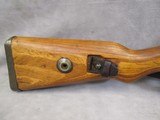
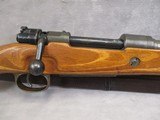
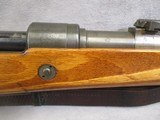
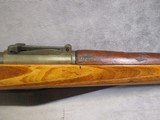
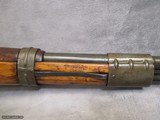
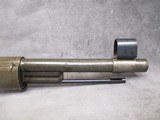
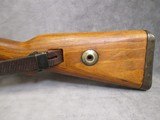
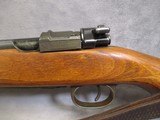
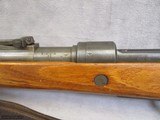
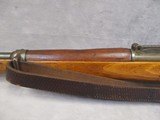
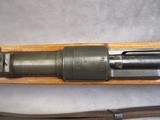
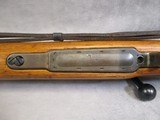
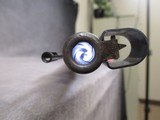
The Kar 98k rifle shown here was produced by the satellite manufacturer d.o.t., which was the German code name for what they called “Waffenwerke Brunn I” (the “I” is a #1). This was the former Zbrojovka Brno factory. For clarification, “Brno” and “Brunn” are essentially the same name (and location), with “Brno” being pronounced similarly to “Brunn”, the spelling difference merely being the difference between the Czech and German way of spelling the city’s name. The rifle was produced in 1944. The rifle is mostly matching with only the bolt having a different serial number (all of the bolt parts appear to match each other). The floor plate has the “byf” code which would indicate Mauser production, but the part has the same serial number as the other parts. The stamped metal components exhibit some rust while the barrel finish is starting has turned into a gray patina in most places. Most, if not all, of the markings remain intact. The bore is in superb shape with the exception of one small spot near the muzzle, which can be seen in the pictures. The pitting is fairly shallow and would not likely affect the accuracy of the rifle. In the past, some Model 98 rifles (all models) were counterbored at the muzzle to a depth of around 30 mm (1.18 inches). This was done to restore accuracy when the muzzle end of the bore was worn excessively by firing. The barrel here has fortunately not reached that state. The bolt still operates very smoothly for a late-war production rifle, and the trigger has the usual take up and break expected of a standard military issue rifle. The screws are in excellent shape and appear as though they have never been turned before. The wood is in good shape for its age, a testament to the strength of laminated construction. This rifle probably has quite a bit of history to it. Like the Lee-Enfield and Mosin-Nagant rifles, the Kar 98k and other Model 98s tend to pop up in regional conflicts all over the world, which speaks to the quality of the design and as well as its capabilities.
SOLD
Rifle Caliber: 8x57mm J
Manufacturer: Mauser (d.o.t. = Waffenwerke Brunn I)
Model: Karabiner 98k
Serial Number: 9242ap
Bore: 4 grooves .0065” deep and .173” wide, 1:9.45 inches (1 in 240 mm) RH twist
Ejectors: Ejection via bolt operation
Condition: Used - Good
Barrels: Carbon steel
Barrel Type: Round
Action: Bolt-action repeater, internal box magazine, M98 action
Triggers: Single
Stock: Laminated beech wood
Fore End: Laminated beech wood
Butt Pad: Metal plate
LOP: 13.0 inches (330 mm)
Finish: Gray patina/blued
Weight: 9 lbs. 4.1 oz.
Sights: Inverted-V front, V-notch rear adjustable in elevation from 100 to 2000 m, sight radius 19.7 inches (500 mm).
Manufacture Date: 1944