 |
 |
 |
 |
 |
 |
 |
 |
 |
 |
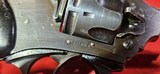 |

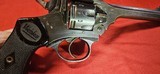
WEBLEY MK1V
Guns International #: 103559289 Seller's Inventory #: 1381
Category: Webley Revolvers - Military Revolvers - Non-US
Seller's Information
When emailing or calling sellers direct, please mention that you saw their listing on GunsInternational.com

Seller: Acme Reloading
Member Since: 5/21/19
First Name: Marvin
Last Name: Mann
State: Florida
Zip: 32086
Country: United States
Phone: (904) 315-8883
Number of Active Listings: 18
Total Number of Listings: 340
Seller: FFL Dealer
Return Policy: 3 day inspection and return policy on used guns.
Payment Types Accepted: master card, visa, discover, postal money order, personal check (must clear before shipping)
Description:
HELLO FROM MERRY & MARVIN AT ACME RELOADING SUPPLY ST AUGUSTINE . BEAUTIFUL VINTAGE REVOLVER IS WHAT WE OFFER TODAY. SHIPPING FROM OUR SHOP SHIPPING, HANDLING AND INSURANCE INCLUDED IN THE SHIPPING COST OF 60.00 NO CC FEES. CONTACT US AT 904-315-8883 OR 904-377-6110
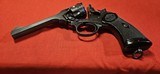
The Webley Mk IV revolver was one of the multitudes of sidearms issued to British and Commonwealth forces during World War II. Although the first Webley entered service in the 1870s, many design features endured in the pistol that armed British officers, pilots, and tank crewmen during the war.
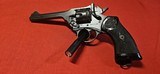
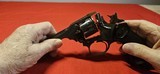
The Mk IV’s distinctive shape is mostly due to its design. Like earlier Webleys, the Mk IV is a top break revolver. Unlike most modern American revolvers such as the Smith & Wesson “Victory” model (which also served British forces during the war), the cylinder and barrel assembly on the Mk IV are released by a lever on the left-hand side of the pistol. Instead of the cylinder swinging out, the barrel and cylinder assembly tilt forward.
As the cylinder and barrel swing forward on opening, the Mk IV’s auto-ejectors expel the (presumably) empty cases from the pistol, enabling the user to focus more on reloading the pistol than emptying the cases manually by pushing an ejector rod. In theory, this method saves the user time.
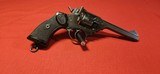
The Webley locks up by means of a square hole in the top strap that engages a post above the hammer and is held together by the iconic stirrup latch. Note cylinder serialized to frame.
A similar mechanism can be found on other comparable revolvers such as the Schofield, a design that dates from the same decade as the original Webley. While this might have been a distinct advantage for a horseman, the rather stiff-breaking nature of the Webley made it insignificantly faster to reload, if at all. Although speedloaders were designed for the Webley handguns, they’re rarely encountered and usually in .455 caliber. Original Prideaux speedloaders command a premium at , and fakes are creeping into the marketplace, so buyer beware.
The Mk IV is a double-action revolver that can be fired single action. Again, in general terms, the actions tend to be stiff, and the trigger pulls heavy. Anybody experienced with Nagant revolvers will find the trigger and actions generally similar. They’re not terribly smooth in “as issued” form, but better built, slicker, and better finished models were made for the civilian market and for contracts not subject to the exigencies of wartime.
In fact, Webley was so concerned about the appearance of its wartime models that many Mk IVs are found with the stamp “WAR FINISH” applied so the user understood that, under “normal” circumstances, Webley put more time into the finish and overall appearance of its revolvers. The finish utilized on Webleys and other British small arms is often considered odd by those who encounter it.
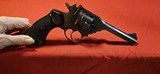
While bluing or Parkerizing was often applied, the exterior of the Mk IV was coated in a special type of firearms paint, which can clearly be seen in the pistol pictured in this article. This paint was (is) prone to scratching and wear, and most firearms so finished, even if lightly used, will demonstrate noticeable wear.
The Mk IV has standard notch and post sights that are serviceable, but not very predisposed to high levels of accuracy. They’re non-adjustable, but in fairness, they’re an improvement over smaller, less-visible sights on other contemporary service pistols. Considering the average engagement range, this wasn’t considered a liability.
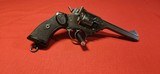
The grips on the Mk IV are serviceable and, being plastic and checkered, are more user friendly in poor weather or when the user has wet or muddy hands. The two-piece grip panel assembly is held together by a single screw.
Overall the grip surface is considered small by some shooters. In addition, the Mk IV has a lanyard ring at the base of the grip. Unlike other nations, the British intended this to actually be used, and in many of not most wartime pictures, the lanyard is in evidence, usually around the user’s neck.
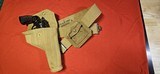
The holster was made of heavy webbing and usually “Blancoed” for camouflage and some degree of weather resistance. Most holsters also held a cleaning rod, and some issued holsters carried spare ammunition as well — although this was more frequently carried in one or two small pouches on the belt or attached to the braces (suspenders).
The distinctive wings forward of the cylinder are designed to aid in holstering — lanyard ring is typical of all service Webleys.
Unlike most of its predecessors, the Mk IV fired the somewhat diminutive .38/200 round, which is almost identical to the .38 S&W cartridge. The Mk VI — also issued during WWII but the primary sidearm during WWI — fired the more powerful .455 round. The .38 cartridge was adopted following ballistic tests in the interwar period that indicated little to no loss of stopping power in downsizing, but notable gains in control and thereby accuracy.
Among the last of widely issued military revolvers by major military powers. By the time of its issue and production, pistols such as the 1911A1, P.35 Browning, and Walther P.38 were largely the norm. In fact, the P.35 was adopted to replace the Mk IV, though complete adoption took what seems to have been a considerable amount of time.
The Mk IV stayed “on the books” with British forces well into the 1970s and collected dust in armories even longer. It was — and is — commonly found in former Commonwealth countries around the world, and they were encountered by U.S. troops in Afghanistan during GWOT. They remain in reserve status with many police forces around the world.
Black enamel paint over roughly finished metal means this probably won’t win any barbecue gun prizes.
Shockingly, this piece of history is actually fun to shoot, although ammunition isn’t commonly encountered and frequently has to be ordered unless one has access to a very well-stocked dealer. It’s easy to handload and shoots non-jacketed lead bullets well. There’s little to maintain, and although it may appear slightly rough around the edges, it’s reliable. At one time large numbers of Mk IVs were imported, but those days are long gone.
Webley Mk IV
- OAL: 10¼ inches
- Barrel Length: 5 inches
- Cylinder Capacity: 6
- Effective ROF: 18 to 24 RPM
- Effective Range: 50 yards (25 yards practical)
- Weight: 2.3 pounds
- Caliber: .38/200
Price: $1,095.00
Manufacturer: WEBLEY
Model: MARKVI
Serial Number: 76804