 |
 |
 |
 |
 |
 |
 |
 |
 |
 |
 |
 |
 |
 |
 |

Inland M1 Carbine .30 Carbine 7-44 Mostly Inland Parts, 6 magazines
Guns International #: 103670227 Seller's Inventory #: 26060077
Category: Military Rifles - M1 Carbine - Rifles - American Semi-Auto
Seller's Information
When emailing or calling sellers direct, please mention that you saw their listing on GunsInternational.com

Seller: Shooter's Supply, LLC.
Member Since: 3/16/16
First Name: Patrick
Last Name: Brown
State: Tennessee
Zip: 37343
Country: United States
Phone: (423) 875-4868
Number of Active Listings: 18
Total Number of Listings: 1392
Seller: FFL Dealer
Return Policy: 3 day inspection and return policy on used guns.
We normally ship USPS Priority Mail which should be 2-day ship. Shipping is actual cost with a minimum of $45 to ship to most of the 48 contiguous states. Shipping to Alaska may require an extra fee. Shipping insurance is available upon request for an extra fee. We cannot do international sales. As of November 2019, we no longer ship guns to California and Hawaii.
Payment Types Accepted: Visa, Master Card, American Express, USPS Money Order. NO CREDIT CARD FEES!!!
About Us: We are a small family owned business located in Hixson, Tennessee. Do you have firearms at home collecting dust? We have a lively consignment business. Our fee is 20% with a $50 minimum. Firearms are consigned for a an average period of 180 days but the length of period is negotiable. We also do handgun carry permit classes for the state of Tennessee. We have a nice indoor shooting range with reasonable rates. Please check us out at shooterssupply.
Description:
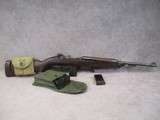
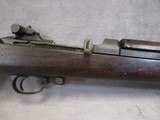
Designed to replace the M1911A1 as an issue weapon for second line and rear-area troops, the M1 carbine was designed with the goal of being lighter than the M1903 Springfield, M1 Garand, and M1A1 Thompson, while providing more firepower than the M1911A1. For all intents and purposes, this goal was reached, but at a price. The M1 Carbine utilized the .30 Carbine round which had been based on what many argue to be the worst cartridge ever devised, the .32 Winchester Self-Loading (32 WSL). That round had been designed for hunting but proved to be underpowered for deer and too large for varmint hunting. In basing the .30 Carbine on this round, Winchester produced a round that was adequate for the task required. At roughly 40,000 Psi, the round was effective out to, at most, 200 yards. On the positive side, the .30 carbine is in the same class as the 357 Magnum. Despite the original intentions behind the M1, the rifle went on to be issued to many US Army personnel, even those serving on the frontlines. A folding stock version, the M1A1, was most famously used by the 82nd and 101st Airborne divisions during their campaigns which took them from Italy (82nd) to France, Belgium, and finally, into Germany. Despite occasional criticisms for lack of firepower past 200 yards, the M1 carbine was well-liked for its light weight and generous (at the time) magazine capacity of 15 rounds. The sights were easy to use, and the rifle would hit any target the rifleman aimed at out to at least 85 yards (from personal experience with my own M1) without having to adjust the rear sight to compensate for distance.
The M1 shown above was built by Inland. At some point, the carbine went through a rebuild as the Dept. of Ordnance ordered all M1 Carbines to be fitted out with certain parts to replace older types whether it be for safety reasons or ease of use by the troops. As such, there are very few M1 carbines that have “matching parts”, especially when taking subcontractors into account. Also, it must be remembered, that when one manufacturer was short of their own parts, others would be transferred from another manufacturer with a surplus to keep production in full swing. While this may sound strange, it should be remembered the many manufacturers that produced the M1 Carbine were not in competition with each other, they all worked for the same customer, the U.S. Ordnance Dept.
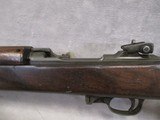
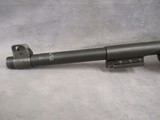
The majority of the parts were manufactured by Inland. This includes the receiver, the barrel, the barrel band, the slide, the sear, the magazine catch, the recoil plate, the stock, and a few others as given below. The barrel band is a Type 3 and has the correct “KI” mark for Inland. However, it should be pointed out that the Type 3 was not used by Inland until around serial number 6.3 million. The slide is a Type L379A, wherein the “L” indicates it is a late type with the curved deflector lug (the arched projection on top in front of the bolt handle). The “3” indicates the arm joint is 9/16” in length, the “7” indicates a flat edge on the rear of the slide box, and the “9” indicates the internal cam cut for the bolt lug has a v-shape at the top. Finally the “A” indicates the approximate distance between the hole on the bottom of the arm and the cam cut as 3/32”. For a better view of what all these characteristics look like in person, check out the ://carbinecal30/slides.html. On the , they refer to the L379A slide as a “Type V.” The uses its own system but for the most part their terms have a corresponding equivalent with the Carbine Club Sheet. In some cases, they use the same type number. Interestingly, the left side of the trigger housing is marked “N” with the number “16” just below it, indicating production by National Postal Meter. Given the relatively low production numbers of M1 Carbines by NPM, this trigger housing is rare in itself. The Type 3 hammer is stamped “B/R” (within a circle) and was manufactured by Rock-Ola. The Type 1 sear (no hole) is stamped “RI” for Inland, while the trigger is marked “SN” indicating National Postal Meter production. The Type 4 rotary safety is marked “J.A.O.”, indicating manufacture by J.A. Otterheim. The Type 4 magazine latch is marked “HI” which, of course, indicates Inland manufacture. The issue is that, being a Type 4 (rather than a Type 5 or 5a), it lacks the little 90 degree arm on the other side for supporting a 30-round magazine. Technically, this carbine should only be used with the original 15-round magazines. While the 30-rounders will latch in, they won’t have the full level of retention support as intended. The front sight (Type 1, milled) is stamped “N” and may have been produced by the Niedner Co. The rear sight is a stamped adjustable type made by L.R. Co. The firing pin appears to be stamped “W” and was probably made by Winchester. Similarly, the bolt has a “W” on the right lug and was made by Winchester. The recoil plate is marked “DI” indicating Inland manufacture. As mentioned previously, the stock was made by Inland, as indicated by the “OI” stamp in the sling cut. The mark itself is upside-down, so it appears as “IO” at first glance. The right side of the stock sports a large Ordnance stamp (the famous crossed cannons). The handguard is stamped “RMC” and was made by Rock-Ola (who made stocks in large numbers for the other manufacturers to use as well as in Rock-Ola’s one M1 Carbines).
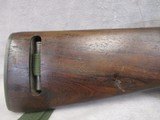
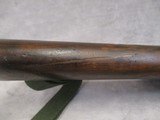
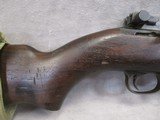
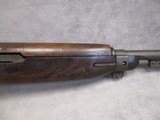
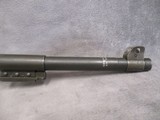
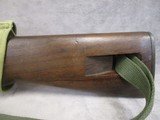
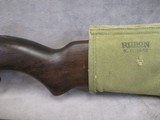
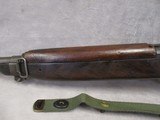
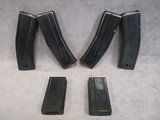
The bore is in fine condition and is very clear when a light is shown through it. The stock possesses a fair number of dings or dents. The most notable of these is on the right side of the butt. It is usually covered by the twin magazine pouch. Please see picture No. 2. A fairly long crack on the very bottom of the butt has been repaired as shown in picture No. 3. There is a small, rectangular ding in the left side astride the magazine well. What is NOT a form of wear, despite its appearance, is a small hole on the left side of the fore end. This is a through hole for installation of the pin which retains the barrel band spring to the stock. It was faster to make a through hole in the stock than a blind hole. It also allows the pin to be pushed out from the other side in the event the stock needed to be refinished or a repair performed which required the removal of all non-wooden parts from the stock. The rifle’s finish is still mostly intact with some wear on the front sight and bolt. Thesling appears to be an original judging by the appearance of the metal components. The twin mag pouch is marked “Rubon” with “K.C. 1942” just below it. The rifle comes with an oil bottle and an excellent reproduction of the Model 74-P-142-705 “Pocket Magazine” which is a belt pouch designed to hold four 30-round magazines. The M1 comes with no less than six magazines - two 15-rounders and four 30-rounders. One of the 30-round magazines is marked “N.V.S.” on the lower back and “Japan” on the bottom. The other three are unmarked. One 15-rounder is stamped “IS” on the back which indicates manufacture by International Silver. This should NOT be confused with magazines featuring an “SI” marking which would indicate manufacture by Seymour Products. The second 15-rounder has the letter “U” stamped on the back, which identifies it as having been made by Union Hardware.
Model: US Carbine, Cal. .30, M1
Serial Number: 5,367,373
Year of Manufacture: Between July and August 1944
Caliber: .30 Carbine aka .30 Carb., 7.62x33mm.
Action Type: Semi-Automatic, gas operated, short-stroke gas piston, closed rotating bolt.
Barrel: Carbon steel, short chamber skirt
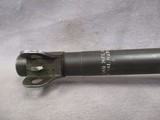
Barrel Markings: top marked “INLAND MFG. DIV.” with “GENERAL MOTORS” below, date of “7 - 44” below that, further back is the letter P, 0.065 inches high; bottom marked with Inland hieroglyphics.
Barrel Length: 18.0 inches (457 mm)
Rifling: 4 grooves, 1:20 inches (1 in 508 mm) RH twist.
Gas Piston Cylinder: Marked “WI” with the “W” being double stamped. This marking was assigned to one of Inland’s subcontractors who were manufacturing GPCs for Inland.
Length of Pull: 13.125 inches (333.375 mm)
Overall Length: 35.625 inches (904.875 mm)
Capacity: 15+1 and 30+1
Receiver: Carbon steel, Type 4 trigger housing lug with “I” mark on the bottom, narrow rear tang, rear hole 3/16”, round mill cut, both front and rear notches, short handguard lip.
Finish: Parkerized
Stock: Wood, upside-down “OI” (Inland) stamp, low wood at slide, large crossed cannons on right side.
Recoil Plate: Marked “DI” = Inland
Forend: see stock
Handguard: Wood, RMC (Rock-Ola) stamp, deep groove
Barrel Band: Type 3, marked “KI” = Inland
Rear Sight: L.R. Co. stamped adjustable rear sight.
Front Sight: Wing-protected post (marked “N” = Neidner Co.).
Sight radius: 21.6875 inches (550.8625 mm).
Scope: None
Trigger Housing: Milled, Marked “N” over the number “16” on the left side = National Postal Meter.
Trigger: Marked “SN” = National Postal Meter
Hammer: M1E1 hammer (Type 3), “B/R” in circle mark = Rock-Ola
Hammer Plunger: “In the white”
Hammer Spring: 26 ½ coils.
Sear: Type 1, Marked “RI” = Inland, no hole
Magazine Catch: Type 4, “HI” mark = Inland
Safety: Type 4 rotary, marked “JAO” = J.A. Otterheim.
Bolt: Flat, parkerized, “W” on right lug. Right lug rounded.
Extractor: Flat type
Firing Pin: Marked “W” = Winchester, parkerized
Ejector: Type 2
Slide: L379A (L = Late cam, 3 = 9/16” arm joint, 7 = slide box rear is flat, 9 = v-top internal cam cut, A = 3/32” approx. distance from hole to cam cut).
Slide Markings: “PI” = Inland, located on the inside bottom, “C” on the outside bottom.
Weight: 6 lbs. 5.9 oz. with sling, stock magazine pouch, and two empty 15-round magazines.
Price: $1,400.00
Rifle Caliber: .30 Carbine
Manufacturer: Inland Mfg. Div. of General Motors.
Model: M1 Carbine (US Carbine, Cal. .30, M1)
Serial Number: 5,367,373
Barrel Length: 18.0 inches (457 mm)
Bore: 4 grooves, 1:20 inches (1 in 508 mm) RH twist.
Ejectors: Auto-ejection
Condition: Used - Good
Barrels: Carbon Steel
Barrel Type: Standard M1 Carbine
Action: Semi-Automatic, gas operated, short-stroke gas piston, closed rotating bolt.
Triggers: Standard M1
Stock: Wood
Fore End: Wood
Butt Pad: Metal plate
LOP: 13.125 inches (333.375 mm)
Finish: Parkerized
Weight: 6 lbs. 5.9 oz. with sling, stock magazine pouch, and two empty 15-round magazines.
Sights: Adjustable Rear, Blade front, sight radius 21.6875 inches (550.8625 mm).
Manufacture Date: Between July and Aug
Extras: See description