 |
 |
 |
 |
 |
 |
 |
 |
 |
 |
 |
 |
 |
 |
 |
 |
 |
 |
 |

Magnificent Purdey Percussion Double Rifle Cased with Original Accessories Built for Lord Leconfield
Guns International #: 103684834 Seller's Inventory #:
Category: Double Rifles - English - Purdey Rifles
Seller's Information
When emailing or calling sellers direct, please mention that you saw their listing on GunsInternational.com

Seller: Grouse Grove
Member Since: 3/17/07
State: Montana
Country: United States
Phone: (406) 442-2322
Premium Seller
Number of Active Listings: 18
Seller: FFL Dealer
Return Policy: 3 day inspection and return policy on used guns.
3 days
Payment Types Accepted:
Description:
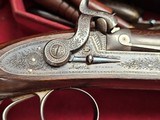
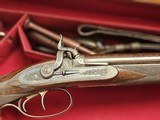
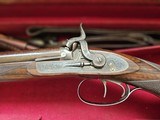
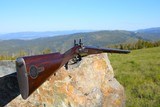
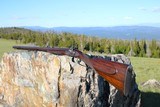
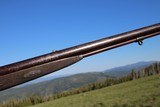
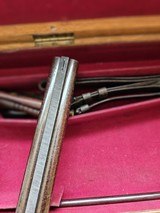
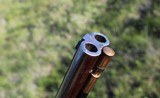
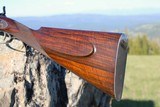
This extraordinary 70 bore Purdey double rifle was completed August 5, 1865, at a price of £84. The barrels are 28 3/4” with two-groove rifling and spotless bores. There is a blade front sight, while the rear sight consists of one folding and one standing leaf.
Patrick Unsworth describes the rifle in his book “The Early Purdeys,” writing: “Cased with outer leather cover and full accessories, including the black lacquered powder magainze. The outer cover bears the name of Lord Leconfield.” (The outer cover is missing.)
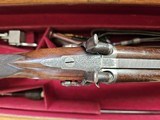
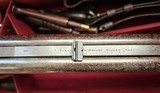
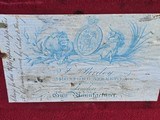
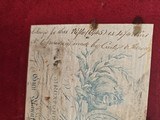
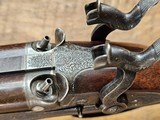
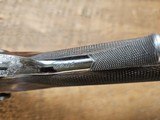
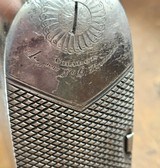
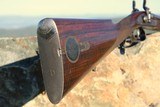
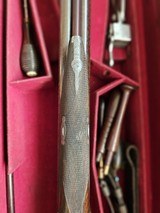
Hand-written notes on the case label say “Charge for this rifle is 4 ¼ drams No. 6 powder as made by Curtis & Harvey." The charge is also engraved on the checkered steel butt-plate. The receiver features the maker's name surrounded by best scroll engraving. The non-rebounding locks function crisply. There are stalking safeties. The lightly figured English walnut stock measures 14 3/8". There is an engraved patch box on the right side of the stock. The rifle comes in its original case with a full complement of accessories, including:
The winged bullet mould numbered to the rifle
Powder magazine
Powder measure
Cleaning rod with tips
The original leather sling
Wad cutter
Hammer nose cleaner
Nipple recess cleaner
Nipple wrench
Short starter
The rifle retains nearly all the wood and metal finishes. Lord Leconfield took extraordinary care to preserve it and clearly didn’t use it a great deal. He did return it to the maker at some point and had the rear sight moved slightly forward, likely to accommodate his aging vision. This beautiful rifle displays the workmanship that created Purdey’s reputation. Most remarkably, the condition is substantially the same as when it left Purdey's premises 160 years ago.
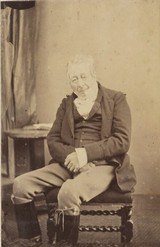
Here is some information on George Wyndham, First Baron Leconfield:
A direct descendant of Sir John Wyndham, Lord Leconfield was born in 1787, the eldest natural son of George Wyndham, 3rd Earl of Egremont, and Elizabeth Ilive. His parents were married in 1801 but had no sons after their marriage.
Wyndham entered the Royal Navy in 1799 as a midshipman on HMS Amelia. In 1802 he transferred to the Army as a cornet in the 5th Dragoon Guards, promoted in 1803 to lieutenant in the 3rd Dragoon Guards. In 1805 he was a captain in the 72nd Highlanders and ADC to Sir Eyre Coote who was Lieutenant Governor of Jamaica. In 1807 he was DAAG to Earl Cathcart at the Bombardment of Copenhagen; in 1809, as captain in the 1st Foot Guards, he took part in the Walcheren Expedition; in 1811 he was a major in the 78th Regiment and the 12th Light Dragoons; and in 1812 he was lieutenant-colonel commanding the 20th Light Dragoons at the siege of Ciudad Rodrigo.
Upon his death in 1837 the 3rd Earl of Egremont bequeathed all his unentailed property to his son, George Wyndham, who therefore became the heir to the substantial Egremont estates, including Petworth House in Sussex. In 1859 he was raised to the peerage as Baron Leconfield, of Leconfield in the East Riding of the County of York.
During the Great Irish Famine, Wyndham was often in residence in his County Clare estate near Ennis where he assisted tenants who wanted to emigrate to Canada. This was a continuation of his father's improving policies in Sussex. In late 1849 and early 1850, a series of seven anonymous essays and illustrations concerning the famine appeared in The Illustrated London News under the title "Condition of Ireland: Illustrations of the New Poor Law." Here the narrator (likely the journalist and philanthropist Sidney Godolphin Osborne) writes of Col. Wyndham that "Colonel Windham . . . is not tired of his fellow-creatures, and does not seek to exterminate them. Not a roofless house did I see here." His property was a "little oasis of humanity in the desert of misery."
Price: $14,500.00
Antique: Yes